
If you’ve ever typed your business into Google and scrolled… and scrolled… and still couldn’t find yourself on page one, you’re not alone. Most small business owners, startup founders, and e-commerce brands ask the same question at some point: how does SEO work, and why isn’t my website showing up?
The truth is, Google isn’t randomly deciding who gets seen. It’s running your website through a complex — but learnable — system of signals. Once you understand how that system works, ranking higher stops feeling like guesswork and starts feeling like a plan.
Here’s exactly how Google ranks websites, and what you can do about it.
How Does SEO Work? The Basics
SEO (Search Engine Optimization) is the process of improving your website so search engines can easily find, understand, and trust it enough to show it to the right people.
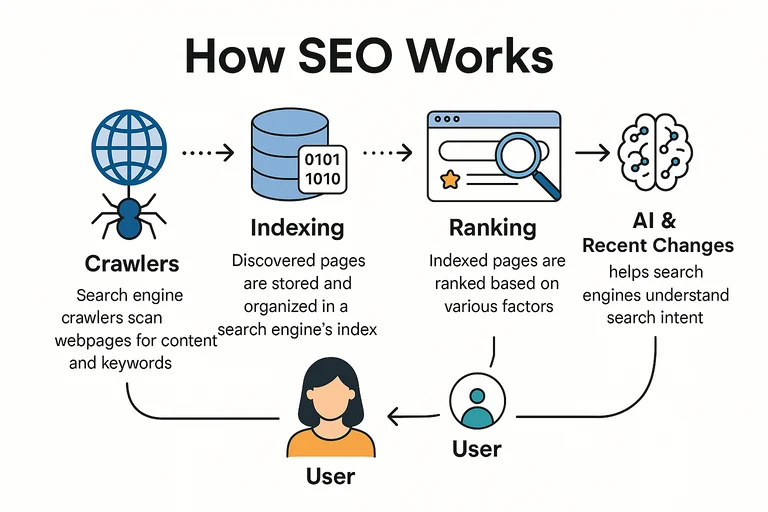
Google ranks websites using three core stages:
- Crawling – Google’s bots scan the web to discover pages
- Indexing – Those pages get stored and categorized in Google’s massive database
- Ranking – Google decides which pages best answer a specific search query
If any one of these stages breaks down — say, Google can’t crawl your site properly, or your content doesn’t clearly answer a question — your rankings suffer, no matter how great your business is.
What Factors Does Google Actually Use to Rank Websites?
Google uses hundreds of ranking signals, but they generally fall into a few major categories.
1. Relevance
Does your content actually match what the searcher is looking for? Google analyzes keywords, topics, and search intent to determine whether your page deserves a spot for a given query.
2. Authority (Backlinks)
When other reputable websites link to yours, it signals trust. Think of backlinks as votes of confidence — the more high-quality votes you have, the more Google trusts your site as a credible source.
3. User Experience
Google pays close attention to:
- Page load speed
- Mobile-friendliness
- Site structure and navigation
- Time visitors spend on your page (a signal your content is actually useful)
4. Content Quality
Thin, generic, or outdated content gets buried. Google rewards content that is original, well-researched, and genuinely helpful — not just written to hit a keyword count.
5. Technical Health
Broken links, duplicate content, missing meta tags, and slow servers all quietly hurt your rankings, even if your content is excellent.
Why This Matters More for Small Businesses and Startups
Larger competitors often have bigger budgets, but SEO levels the playing field. A well-optimized local bakery or a niche e-commerce store can outrank a national brand for the searches that matter most to their actual customers — if the fundamentals are done right.
The catch? SEO is a long game built on hundreds of small, correct decisions made consistently over time. That’s usually where businesses get stuck — not from lack of effort, but from not knowing which signals to prioritize first.
How Marketing Sense Approaches SEO
This is exactly the gap Marketing Sense was built to close. Rather than chasing quick tricks that Google eventually penalizes, our team focuses on the fundamentals that actually move rankings: technical audits, content strategy built around real search intent, and authority-building that compounds over time.
For businesses comparing options and searching for the best SEO agency, the difference usually comes down to one thing: agencies that explain their strategy versus agencies that just say “trust us.” Marketing Sense does the former — every recommendation is tied to a ranking factor you can understand and track.
Ready to Rank Higher on Google?
Understanding how SEO works is the first step. Actually implementing it — correctly, consistently, and without wasting budget on outdated tactics — is where most businesses need support.
Get a free SEO audit from Marketing Sense and see exactly where your website stands, what’s holding you back, and what it would take to move up the rankings. [Contact us today to get started.]
Frequently Asked Questions
How long does SEO take to work? Most businesses start seeing measurable movement within 3–6 months, with stronger results building over 6–12 months as authority and content compound.
Is SEO better than paid ads for small businesses? They serve different purposes. SEO builds long-term, sustainable traffic, while paid ads (PPC) deliver faster, short-term visibility. Many businesses benefit from using both together.
How do I know if my website needs SEO help? If you’re not ranking on page one for your core services, have slow page speed, or haven’t updated your content strategy in over a year, it’s a strong sign you need a professional SEO review.
What’s the difference between on-page and off-page SEO? On-page SEO refers to elements you control directly on your website (content, keywords, site structure), while off-page SEO refers to external signals like backlinks and brand mentions that build authority.